
Bristol Bay
A great reminder of why so many are fighting for Bristol Bay. Read Bristol Bay's Best Rainbow Fisheries by longtime SAA supporter Ken Morrish of Flywater Travel.
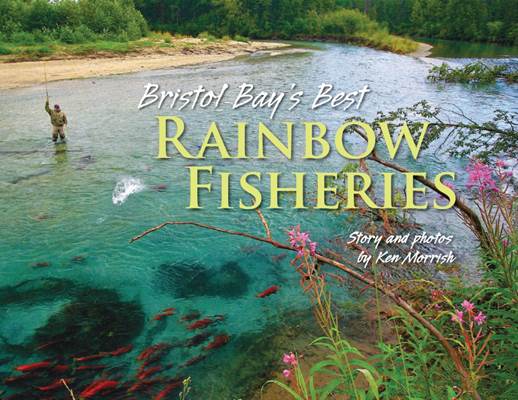
For a taste of why Bristol Bay is so highly regarded by sport fishermen, read this tremendous article complete with gorgeous photography. You’ll want to plan a trip as soon as you read it!
TRCP's Conservation Field Notes
Steven Rinella discusses the potentially catastrophic effects of the proposed Pebble Mine in Alaska's Bristol Bay in a recent episode of TRCP's Conservation Field Notes.
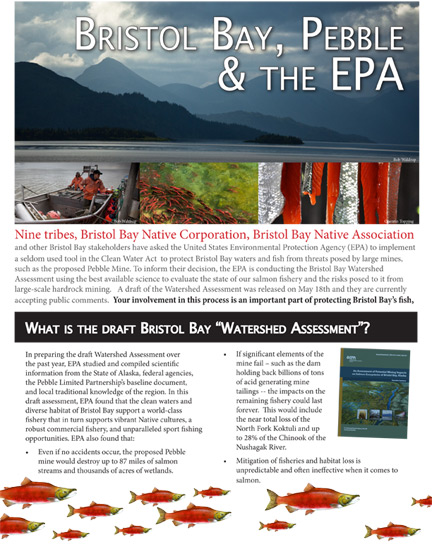
Click to read entire article.
Official EPA Web Site for Bristol Bay
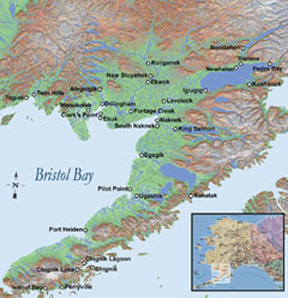
The U.S. Environmental Protection Agency has established a Web site detailing their work in Bristol Bay. You can read official documents, follow EPA’s work schedule in the region, and sign up for a Bristol Bay newsletter from EPA to be kept up to date directly from the agency.
Visit the site to learn what the EPA is doing about Bristol Bay, and sign up to be kept informed of the process.
Pool 32 online magazine features huge coverage of Bristol Bay
The new online magazine Pool 32 provides an incredible amount of coverage to the campaign to protect Bristol Bay.
Take the time to visit this site, and enjoy the commentary and collection of beautiful images. The feature includes discussion of the commercial, subsistence, and sport fishing values of the region…including a segment penned by Sportsman’s Alliance for Alaska Director Scott Hed.
Many thanks to Marcus Wengler, the dedicated creator of Pool 32, for compiling such a magnificent portrait of Bristol Bay and what is at risk from the proposed Pebble Mine project.
Pebble Mine is a Trojan Horse Video
Pebble Mine is a Trojan Horse from Renewable Resources Coalition on Vimeo.
This video is used across the world to educate people by summarizing the risks and dangers posed by the Pebble Mine. Pebble is a proposed mine located in the heart of the Bristol Bay Fisheries Reserve in Southwest Alaska. Home to the largest runs of wild salmon on the planet and nearly every species of Alaskan wildlife. Bristol Bay would forever be changed by this behemoth project, and Alaskan's would be left with the mess for eternity.
Map of Existing Mining Claims in Bristol Bay Region
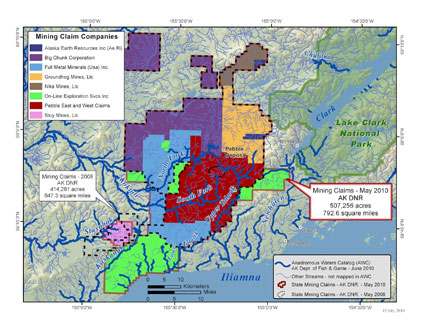
Map of the existing mining claims on state lands
in the Bristol Bay region.
Click the image at right to view an updated map of the existing mining claims on state lands in the Bristol Bay region. In addition to the proposed Pebble Mine, there are several other companies waiting in the wings, with a total of nearly 800 square miles of claims.
Technical Aspects of the Proposed Pebble Mine Project
For a very comprehensive and educational look at the technical aspects of the proposed Pebble Mine project, visit www.PebbleScience.org. This site was initiated by Alaska scientists working for non-profits, universities, and tribes.
The site covers things like acid mine drainage, seismic risks, waste disposal, water impacts, effects of copper on salmon, etc. It’s very well-worth checking out.
Sportsman’s Alliance for Alaska helps lead effort to protect BLM lands in Bristol Bay
In late August, 275 members of the sporting community sent a letter to Secretary of Interior Ken Salazar and BLM Director Bob Abbey, asking that the BLM not open one million acres of federal lands in the Bristol Bay region to mining. SAA helped spearhead this letter, by securing sign-ons from a wide variety of sporting interests: catch and release fishing groups like Trout Unlimited and the Federation of Fly Fishers to big game hunting organizations like Dallas Safari Club, and dozens of fishing product manufacturers to firearms makers like Sturm Ruger & Co. View the press release and copy of the letter and signer. Also, visit the Latest News page for media coverage of the BLM letter.
In October, SAA Director Scott Hed traveled to Washington, D.C., to participate in Bristol Bay Wild Salmon Week. Over 40 meetings were held in the course of three days, with federal agencies and Congressional offices, all with the purpose of raising awareness among decision makers about the threats facing Bristol Bay.
There will be increasing opportunity for concerned anglers and hunters from all over the country to participate in the campaign to protect Bristol Bay. Make sure to join the SAA (it’s free, after all) to stay informed on Bristol Bay and other Alaska conservation issues of importance to sportsmen and women!
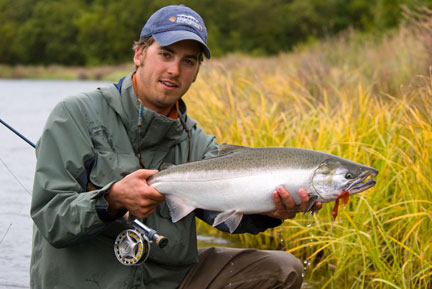
Photo Credit: Jim Klug
Bristol Bay Public Service Announcement
|
Trout Unlimited celebrated its 50th year as an organization in 2009. Watch this short clip from their 50th anniversary video – this segment focuses on the Bristol Bay campaign. This clip was also included as a PSA on the new 2009 DVD “Rise” from Confluence Films.
|
|
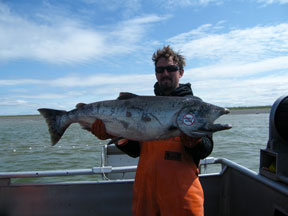
Alaska’s Magnificent Bristol Bay Fisheries at Risk
Clean Water ballot initiative fails to pass Alaska vote
On August 27, 2008 the Renewable Resources Coalition (RRC) published a news release stating, "The RRC would like to acknowledge the tens of thousands of Alaskans who supported Proposition 4 as we did and the hundreds of volunteers who worked so diligently on this issue. The fight to save Bristol Bay’s wild salmon is hardly over, and the results of this election simply show how much work we still have ahead of us." Read more ...
The Land and The Resources
The rivers and streams in the Bristol Bay watershed of Southwest Alaska read like a dream destination wish list for fly anglers around the globe. Nushagak. Mulchatna. Koktuli. Kvichak. Upper and Lower Talarik Creeks. The list goes on and on. For those who have been fortunate enough to wet a line in these waters, it’s an experience likely to never be forgotten. For all who have yet to do so, the dream endures as we keep waiting and saving for that “once-in-a-lifetime” trip.
- Read the Sporting Conservation Petition for Bristol Bay and sign on with your support.
- Get the latest news on Pebble Mine and Bristol Bay.
- Read Scott Hed's article from the Dallas Safari Club's Spring 2007 issue of Game Trails, "Pebble Mine Proposal Threatens Bristol Bay" (pdf file size 2.5M).
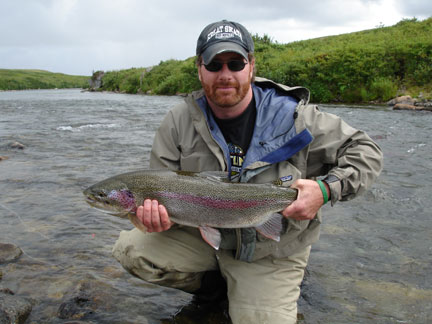
Trophy rainbow from the Bristol Bay watershed.
©Brian Kraft
While wild salmon stocks in many parts of the world are in peril, Alaska represents a place where these magnificent fish still return in such abundance that the numbers are staggering and nearly impossible to comprehend. And no where in Alaska, do so many salmon return as to the Bristol Bay watershed.
Just a few of the superlatives in this region include:
- The Kvichak River is home to the world’s largest sockeye salmon run and is also within Alaska’s designated trophy wild rainbow trout area. Other species found in the Kvichak include Chinook (king), Coho (silver), pink and chum salmon, Arctic Char, Arctic Grayling, Dolly Varden, northern pike, and whitefish.
- The Nushagak and Mulchatna Rivers support the largest Chinook (king) salmon runs in Alaska, and perhaps the world. Other species found in these drainages include Sockeye, Coho (silver), pink and chum salmon, Arctic Char, Arctic Grayling, Rainbow Trout, Lake Trout, Dolly Varden, northern pike, and whitefish.
- Lake Iliamna is Alaska’s largest lake and America’s last undeveloped “great lake” as it is the same size as Lake Erie. It is home to one of only two freshwater seal populations in the world, as well as all five species of Pacific salmon, Arctic Char, Arctic Grayling, Dolly Varden, Rainbow Trout, northern pike, and whitefish.
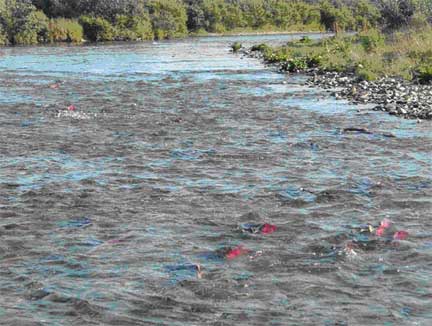
The Sockeyes return by the millions.
©Alaska Sportsman’s Lodge
Other wildlife species that inhabit the millions of wild acres in the Bristol Bay region include healthy populations of moose, sea otter, seal, walrus, grizzly, brown, and black bear, beaver, wolverine, porcupine, river otter, fox, bald eagle, caribou, beluga and killer whale, wolves, and many species of waterfowl and migratory birds.
In addition to the rich fish and wildlife resources of the region that are prized by sportspersons seeking the type of opportunities to recreate in a truly wild region like Bristol Bay, the land supports other uses. Numerous native villages are found in the area whose residents harvest fish and game to support their lifestyle which still depends on subsistence activities to a large degree. And the Bristol Bay watershed produces the world’s largest commercial salmon fishery, harvesting over 25 million fish, employing thousands of people with sustainable jobs, and playing a very integral role in Alaska’s economy as it has done for generations.
What’s a place like this worth? Some would say it’s priceless. Or that they wouldn’t give it up for all the gold in Fort Knox. Well, we’re about to find out if paradise does indeed have its price.
The Threat
A Canadian mining corporation wants to create one of North America’s largest open pit gold-copper mines, the proposed Pebble Mine, within a much larger potential mining district in the headwaters of Bristol Bay.
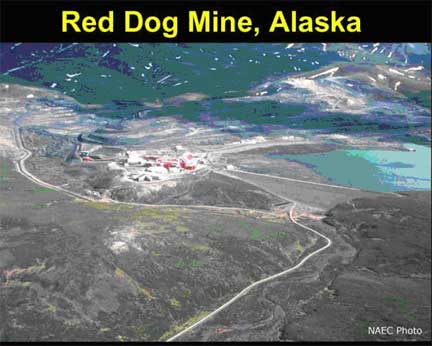
Red Dog Mine in the Northwest Arctic, Alaska. The proposed Pebble Mine
alone would produce 20x the ore output as Red Dog. According to the US
Environmental Protection Agency, Red Dog is the single-largest source of
toxic pollution in the United States. ©Northern Alaska Environmental Center.
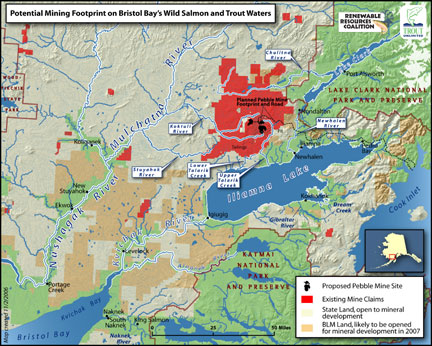
The Bristol Bay region is home to some of the most productive rivers
in
Alaska. It's also being threatened by mining claims that could
change
thousands of square miles of this wild region forever.
©Renewable Resources Coalition and Trout Unlimited.
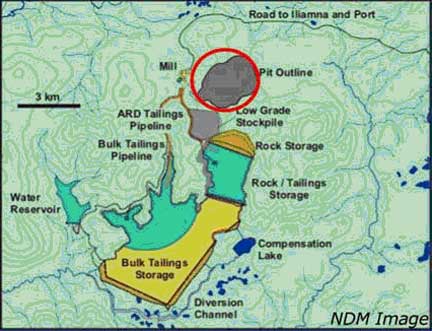
Proposed Pebble Mine Plan. In this image, the pit is approximately two
miles
wide, while the toxic tailings lagoon covers nearly 20 square miles.
©Bristol Bay Alliance with image from Northern Dynasty Minerals.
At the same time, the federal Bureau of Land Management is trying to open 3.6 million acres to hard-rock mining. According to the EPA, the hard-rock mining industry is the single largest source of toxic releases in the US and this industry has caused enormous damage to rivers and fisheries around the world. The proposed Pebble Mine and Bristol Bay Mining District may pose the greatest single threat facing Alaska's salmon-bearing rivers and the people who depend on them. All told, thousands of square miles of state and federal lands are at risk.
Furthest along, and garnering the most attention to date, is the proposed Pebble Mine project. Although the company continues exploration and continues to refine its plan in hopes of applying for permits in 2008, early plans have indicated the possibility of a pit 2.5 miles wide and a toxic lagoon covering close to 20 square miles. The mines proposed upstream from Bristol Bay and its tremendous renewable fishery could release arsenic, sulfuric acid, cyanide, heavy metals including lead, cadmium, zinc, mercury, and many other toxic pollutants that kill fish and cause human health problems such as cancer and neurological damage. Toxic spills and leakages that cause short- and long-term damage to aquatic resources are not isolated, unusual events but are common to hardrock mines where large toxic tailings ponds are present.
And remember that the Pebble project is only one of many mines envisioned for this region. The fact of the matter is, this threat is real and its consequences are enough to make the hardest cynic think twice.
The list of voices speaking out against the proposed mining district in Bristol Bay is long and includes some impressive, if unlikely, names.
- United States Senator Ted Stevens (R-AK)
- Many native tribal and village corporations in the region
- Alaska Wilderness Recreation and Tourism Association
- Trout Unlimited
- Alaska Inter-Tribal Council
- Alaska Magazine
- Fly Fisherman Magazine
- Alaska Independent Fishermen’s Marketing Association
- David Keene, Chairman of the American Conservative Union
- Alaska Bowhunters Association
- Anchorage Daily News
- National Wildlife Federation
- Federation of Fly Fishers
In addition, the Rocky Mountain Elk Foundation and the Safari Club International have voiced serious concern about these proposals and supported a resolution in the Alaska House of Representatives to require the AK Dept. of Natural Resources to conduct a thorough review of the Bristol Bay Management Plan as it pertains to mining.
What’s Next?
These proposals are in their early stages, but that also represents the greatest opportunity for anglers and other sportsmen and women to weigh in with the appropriate parties regarding these ill-conceived plans. There are several things you can do…
- The BLM is accepting comments on their proposed plans for the millions of acres under its management in this region. You may submit a comment by visiting this web site:
- If you would like to learn more about the Bristol Bay region and the threats it is facing, there are a few web sites you can visit:
- www.tu.org/bristolbay
- www.renewableresourcescoalition.org
(you can watch a 4-minute video on the subject here) - www.bristolbayalliance.com
- Several publications have written stories on this matter in recent months, including:
- Trout Unlimited
( www.renewableresourcescoalition.org/TUPebbleStory.pdf) - Fly Rod & Reel magazine
( www.flyrodreel.com/index.php/page/issues/sku/FRR2006_1112/id/19174) - Fly Fisherman
( www.flyfisherman.com/alaska/jrpebble/) - Alaska Magazine
( www.alaskamagazine.com/stories/0206/viewnorth.shtml) - Mother Jones
( http://motherjones.com/news/feature/2006/05/midas_touch.html)
- Trout Unlimited
- Finally, if you’ve visited Bristol Bay in the past to fish or you hope to do so some day and experience one of the truly greatest fishing experiences on earth, take a moment to send a quick note to Alaska’s state politicians letting them know why you spend your hard-earned dollars and travel thousands of miles to enjoy the Last Frontier.
- Governor Sean Parnell (http://gov.state.ak.us/govmail.php)
- Lt. Governor Sean Parnell (http://ltgov.state.ak.us/email.php)